

Creating content based on gut feel is like navigating in the dark. It’s not just inefficient, it’s ineffective too. Audience preferences are not met, opportunities are missed, and, even if you’re using AI, creating content becomes increasingly expensive. Without illumination, aka insights into what your audiences want to read, your content stays reactive and disconnected from both customer expectations and business needs.
This is why understanding which metrics are useful, and which are among the worst B2B marketing metrics to rely on, is essential.
Measurement: complex for tech B2B
The range of marketing metrics measured today by tech B2B is bewilderingly large.
While no two companies follow quite the same approach, measurement frameworks tend to mirror the age-old tension between marketing and sales: one side trying to prove influence and pipeline contribution, the other often resisting.
But the real reason there is no single, universal set of metrics is that the buying journey itself is recognised to have become more complex and content-dependent. We no longer deal with a neat AIDA funnel. It is a ‘messy middle’ of multiple search, content consumption and evaluation cycles carried out by a committee of influencers and decision-makers.
To track performance in this ecosystem, our measurement models have had to evolve, but not all metrics have kept up with reality.
The way we measure performance today is a reflection of how modern customers actually buy.
Metrics marketers don’t understand
To understand what metrics do not work, we reviewed research from Gartner, Forrester, IDC, LinkedIn B2B Institute, and The CMO Survey. None of these sources provided “adoption percentages” for poorly used metrics, but they did identify where B2B marketers lack capability, maturity, or understanding. From these, we inferred the least understood and least used metrics in B2B.
1. Multi-touch attribution (MTA) and influence modelling
What is it?
MTA is a measurement strategy that assigns value to every marketing and sales interaction that contributes to a buying decision across a long, multi-stakeholder journey. Instead of giving all credit to the first touch or the final touch, MTA attempts to quantify how different signals (search activity, content downloads, demos, events, nurture emails, analyst interactions, partner activity) contribute to deal progression.
Why use it?
Since a purchase journey typically spans several months and influence can come from many unseen digital behaviours, MTA is an effort to map contribution across the entire revenue engine.
Why it is rarely used
This is because in the real world, most tech B2B organisations simply do not have the resources or data maturity for it. For example, MTA requires integration across ad platforms, CRM, and sales systems. Very few tech B2B companies can claim to have this in place.
Additionally, MTA struggles in environments where offline interactions, dark social, and partner ecosystems play a large role, making it one of the worst B2B marketing metrics to depend on at early maturity levels.
2. Marketing ROI / ROMI (true return on marketing investment)
What is it?
ROMI is the financial value created by marketing relative to the total cost of delivering it.
A true ROMI calculation links spend to revenue by connecting marketing activity to pipeline creation, opportunity progression, win rate uplift, deal size changes, retention improvements, and expansion revenue. It includes both direct costs (media, technology, content, events) and indirect costs (team, overhead, sales enablement).
Why use it?
ROMI provides the strongest alignment between marketing, sales and finance, elevating marketing to the boardroom and framing it in the same terms used by sales and the CFO. It quantifies how marketing contributes to pipeline creation, deal progression, win-rate improvement and retention.
Why it is rarely used
ROMI is another example of a metric that requires a level of sophisticated financial linking of spend → pipeline → revenue, which few organisations have. If it were possible, it would be an ideal metric, but many organisations use proxy metrics such as lead volume and SQLs instead of true ROI.
Even when attempted, ROMI often becomes directionally useful rather than numerically precise, making it risky when positioned as a “single source of financial truth.”
3. Customer Lifetime Value (CLV)
What is it?
Customer lifetime value (CLV) can be a practical marketing metric in tech B2B when it’s treated as a guide for where to focus time, budget and effort. The principle is simple: if some customer segments generate far more value over their lifetime than others, marketing should prioritise finding and keeping more of those customers.
Why use it?
CLV is a useful metric when it comes to planning future activity. It can help organisations decide which industries, accounts or products deliver the strongest long-term return, especially given that a significant proportion of revenue comes from repeat business across the board in the sector.
Why it is rarely used
According to IDC, most B2B companies cannot calculate lifetime value (LTV) accurately because of business complexity: multiple product lines, multiple account handling teams and jurisdictions, and recurring revenue layers. Marketers often apply simple LTV models from B2C/SaaS that don’t reflect real account behaviour.
In tech B2B, CLV can mislead more than it informs unless grounded in enterprise-grade data. It’s another reason it often appears on lists of the worst B2B marketing metrics to rely on for quarterly decision-making.
Which metrics are widely used
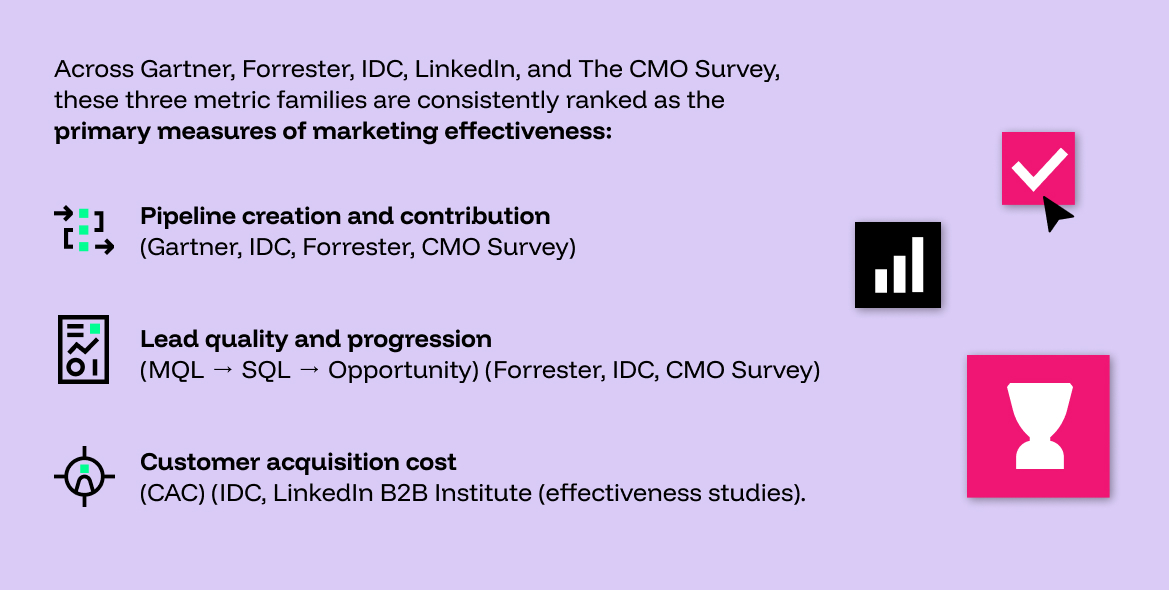
To balance the limitations of the harder-to-measure metrics above, CMOs are shifting toward simpler, revenue-aligned measurement models.
Gartner’s CMO Spend & Strategy Surveys consistently peg the top three marketing-effectiveness metrics for CMOs as:
- Pipeline contribution
- Revenue impact / commercial outcomes
- Acquisition metrics (lead volume, conversion)
However, like all content, performance measurement and reporting must minimise complexity. If a metric cannot be measured accurately or repeatedly, it risks falling into the category of “high effort, low insight”: the true definition of ineffective or ‘worst’ metrics.
Whichever metrics you choose to run with, you must be able to create them accurately, understand them well, and be able to shape and revise your strategies based on them.
A recent in-depth piece we did with a small group of B2B marketing experts revealed their preferred metrics: you can find them in our blog on trusted content metrics.
Final thoughts: find what works for you
Smart tech B2B marketers should treat measurement not as a project to complete, but as an enabler for a persistent state of readiness, building campaigns that adapt, scale, and thrive through change.
The most effective approach is to begin with a small, reliable set of commercial metrics, and only introduce more sophisticated ones once data maturity supports them.
In fact, if John Wanamaker were alive today and career-switched from department stores to tech B2B, he would no longer need to lament about not knowing which half of his advertising was wasted.
With the right measurement framework, modern marketers finally have the opportunity to know.
As always, if you’d like to have a chat about setting measurement frameworks in place for your markeing organization, please reach out at anu@isolinecomms.com.
Like what you just read?
There’s more where that came from. Sign up to our newsletter to get the latest B2B tech news, content marketing insights, tips, tricks, memes, and more, delivered straight into your inbox every month.