
75% of B2B buyers today prefer a sales rep-free experience. Making sure you’re getting the right content to the right person at the right time is more important than ever. Buyers are depending on their own research, ergo your content, to shape the lion’s share of their buying journey.
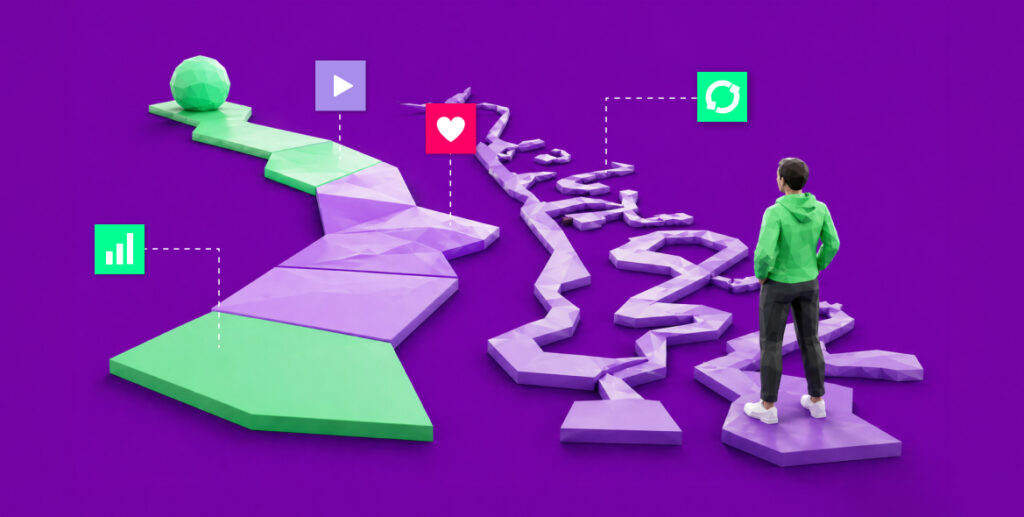
For many organisations, this has meant creating entirely separate content pipelines for every possible persona. But in our previous blog, we explored how the buyer journey is no longer linear, and why content must be built around a single, cohesive narrative.
Knowing this is one thing, operationalising it is another.
Most teams still struggle with the practical questions: what content goes where? If everything ladders up to the same story, how do you create different paths into it? And how do you avoid producing disconnected assets that dilute your narrative?
Define the anchor
Before mapping channels or formats, define the asset that holds the full story.
An effective content ecosystem has a gravitational centre. This is the piece that articulates the core problem, the stakes, your perspective, and your solution. It might be a flagship whitepaper, a pillar webpage, a research report, or a narrative-led solution hub. What matters is that it captures the complete argument. Without this anchor, content fragments. With it, every other asset has a clear purpose: to draw buyers closer to that central narrative.
The mistake many teams make is starting at the edges. They create social posts, blogs, and campaigns before clarifying what everything is meant to build toward. Instead, begin with the destination, then design the journey around it.
Understanding intent across the journey
The buyer journey might be messy, but buyer intent still evolves in recognisable ways. Rather than thinking in rigid funnel stages, think in shifts in mindset.
Early on, buyers are trying to understand their problem. They might be sensing some kind of friction or risk, but they haven’t defined it clearly. Content at this stage should frame the issue in your terms. Thought leadership articles, insight-led posts, and data-driven content can work to introduce that tension without pushing for commitment. These assets can function as entry points into the broader story.
As buyers move into the exploration phase, their mindset shifts. They’re now weighing up approaches and looking for credible guidance. This is where deeper assets, such as webinars, in-depth guides, and case studies, can provide substance and expand the narrative. They connect the initial problem to a structured solution, while reinforcing your point of view.
At the decision stage, the priority then moves to validation. Buyers need confidence that your organisation can deliver. Detailed case studies, ROI tools, and solution pages reduce perceived risk. At this point, your anchor asset often becomes central. It consolidates the narrative and supports a clear conversion action.
The key is not to treat these as separate stories. Each stage should feel like a progression into the same argument.
Different paths, one narrative
In an omnichannel environment, buyers aren’t entering the funnel at the same place. A CFO might have found you from an interesting thought leadership piece on LinkedIn, whilst a technical lead might have read your detailed article about implementation challenges.
This is where the ‘one story, many ways in’ comes into play. Content might differ in emphasis and language, but the underlying narrative remains consistent. Each asset acts as a “thumbnail” of the larger story. By isolating one dimension of the problem or solution, content that addresses the same overarching narrative can be made relevant to a specific persona or channel.
This approach prevents the common stumbling block of creating entirely new campaigns and messaging for each audience. Instead, you’re reframing a single story through multiple lenses, and the narrative integrity remains intact as access points multiply.
From campaigns to ecosystems
Mapping content to the buyer journey requires a shift in mindset. Rather than thinking in isolated campaigns, think in ecosystems.
In a campaign model, assets are often produced solely to fill a calendar. In an ecosystem model, each piece has a defined role. Some assets amplify the narrative at scale, others deepen understanding, while others validate and convert. The key is that all of them connect back to the same central anchor. This structure makes omnichannel execution much more cohesive. Social, email, web, and events are no longer running along separate tracks. Instead, they serve as distribution layers for different facets of the same story.
In a messy journey, clarity wins
The buyer journey is going to stay unpredictable. What you control is narrative clarity. Mapping assets to the journey isn’t about producing more content, but ensuring every piece has a strategic role and moves buyers closer to a single, well-defined story. Isoline can help you develop a content ecosystem tailored to your target audiences. Reach out at hello@isolinecomms.com to find out how.
Like what you just read?
There’s more where that came from. Sign up to our newsletter to get the latest B2B tech news, content marketing insights, tips, tricks, memes, and more, delivered straight into your inbox every month.