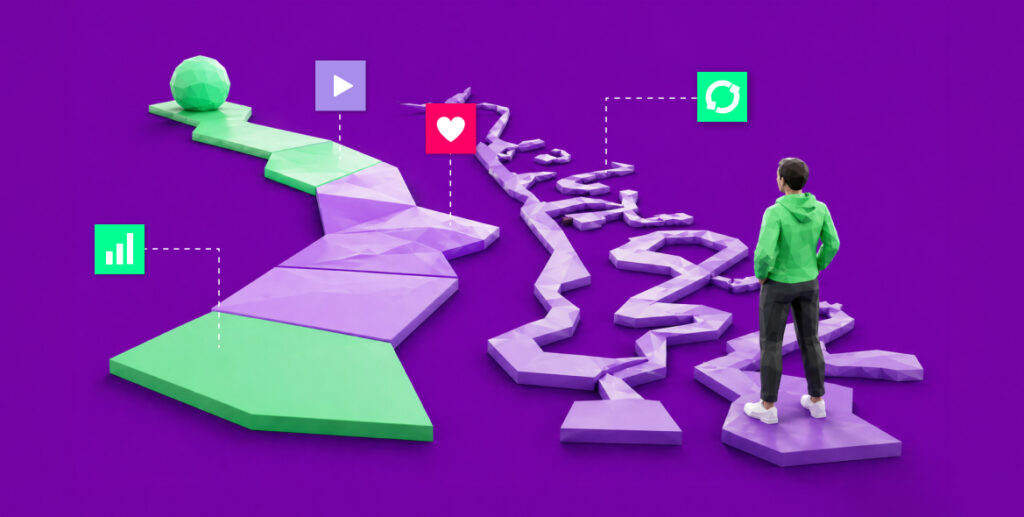

We’re all used to thinking about the B2B marketing funnel as a clean-cut, downward path. It’s structured and linear, and leads prospects neatly from awareness to consideration and beyond.
Here’s the thing: today’s buyers don’t behave like that. Their journeys aren’t straight lines. They jump back and forth. They’re doing more research than ever before. And they’re making decisions influenced by multiple touchpoints – and multiple stakeholders, each with their own priorities – long before they speak to a salesperson.
The stages of the buying journey are still useful, and thinking about content as being top, middle, and bottom of funnel will always be important. But it’s all part of a messy story, an ongoing and constantly evolving buyer journey that can’t be well served just by working down a content checklist. These days, simply having content mapped to each stage isn’t a strategy that’ll deliver.
Why forcing the B2B marketing funnel doesn’t work
Any marketer that’s been in the industry for a while has been guilty of trying to push prospects through the funnel before they’re ready. We’ve all run a campaign that’s rushed to close the deal before building any real connection, often when MQLs are the main KPI, which leads to less than impressive results.
Prospects don’t want to be ‘pushed’ at all. Yet we see this happening all the time. In fact, it inspired our interactive “Playing Hard to Gate” report, which brings the crux of this challenge to life.
So, what’s the right answer? Well, since we can’t know for certain where a customer is in their own buyer journey, we find it’s best to think about the funnel as being less straight line and more continuous, non-linear cycle. When it comes to TOFU and MOFU, where prospects will be spending a lot of time, this means thinking about content that can ‘stack’. The result is a series of assets that together serve the needs and intents of different stakeholders.
Modern buyer journeys need modular content
Unsurprisingly, this is an approach we’re fond of. And like the Ronseal of content marketing, we’ve given it a name that does exactly what it says on the tin: the modern B2B content stack.
You can think of a content stack like building with Lego. Each campaign asset stands alone, targeting a specific persona or pain point for exploration and self-discovery. But, when connected together, they create a much bigger, richer story in a way that drives added value up front and further supports how buyers behave today.
A content stack example for a high-ticket B2B service provider
Imagine you sit in the marketing team for a high-ticket B2B service provider, promoting a solution made up of several complex parts. The customer knows they have this problem, but solving it requires significant investment and can sometimes feel insurmountable. On the surface, this might look like a differentiation challenge. Yet there’s also an education piece; helping buyers understand the urgency to act – and act in a way that’ll drive long-term benefits.
A content stack can help here. Instead of creating a handful of purely funnel-led assets, a content stack is a modular approach that’s akin to content engineering. It’s designed to support non-linear journeys where prospects drop in and out and seek answers to specific needs, while creating a series that ladders up to sell the future state vision. It associates your brand with solving the pain behind the pain, and the big problems that typically can’t be fixed with a plug-and-play solution.
A simple content stack for our high-ticket B2B service provider might look like this:
- The tip of the iceberg: a master overview. Think an ungated, interactive scrollytelling content piece introducing the problem/what customers are trying to achieve and the components that must come together to solve it.
- The deeper dive: standalone assets that go deep into each of those components, providing practical steps to address them. This content serves a mix of personas across stages targeting a specific pain point, and can be promoted individually but also embedded into the master overview.
- The nurture flywheel: a mix of content formats you’d typically use to attract and engage, but built around the content stack sitting at the heart of your value-up-front campaign.
Why content stacks are a smart approach
The benefits are three-fold:
- It means efficient content production: internal alignment is often easier and more streamlined. A content stack provides multiple routes for activation.
- It empowers buyers for deeper engagement: built-in support for non-linear buyer journeys. Prospects can enter through deep dive content about their immediate pain point, then ladder up to related assets that help frame the overall solution narrative.
- It is designed for velocity and longevity: A content stack means flexible content that can be versioned out for ABM and repurposed for use across other teams. Each deep dive asset is perfect for repurposing, which makes supporting assets a much easier lift.
Ultimately, a content stack creates a structured, reusable foundation that can drive deeper engagement with your target audience – and with content that doesn’t force prospects down a neat path laid out by the B2B marketing funnel.
Pairing this with a solution like 6Sense, you’ll know exactly how each prospect is engaging with the stack. You can then build your nurture flywheel to suit, responding to each buyer’s unique journey for a smoother, more relevant experience from the get-go.
Tried an approach like this yourself? How’s it working for you? Let us know! hello@isolinecomms.com.
Like what you just read?
There’s more where that came from. Sign up to our newsletter to get the latest B2B tech news, content marketing insights, tips, tricks, memes, and more, delivered straight into your inbox every month.