

Sales and marketing: a feud as old as time.
More intense perhaps than the Montagus vs Capulets. More intense even than Selena vs Hailey Bieber.
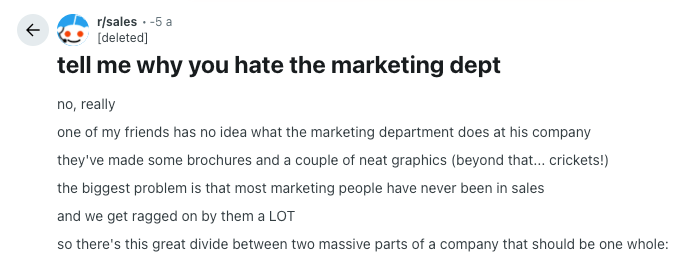
And why is that, really? After all, the goals should be the same: bring more revenue to the table and help the company grow. And yet, time after time there is friction. Marketers complain that sales don’t use their assets properly, sales complain that marketing gives them the wrong leads. But when it works, the sales and marketing collaboration is spectacular.
My first marketing job was in-house, I was a team of one versus an army of salespeople, and it was a brilliant learning experience. They let me join their pitches and listen in on calls (a goldmine of information!) and, in return, I involved them in a company-wide marketing social selling competition. The lines were blurred and it worked for us (see our case study here).
So it’s my belief that the sales and marketing departments can absolutely play well together, provided they understand where the other party is coming from. I wrote this blog in this spirit, to help marketing teams put themselves in their sales teams’ shoes for a second.
Let’s begin with some common frustrations and misunderstandings.
5 top misunderstandings marketing have about sales
1. “Marketing thinks we need more leads. Sales thinks we need fewer, better ones.”
This complaint is a classic one: marketing chases quantity, sales chases quality. At least that’s how it can look from the sales point of view.
In defense of marketing teams, when that’s the case, it’s generally because there’s pressure from higher up to deliver a sky high amount of leads. As a result, marketers will deploy multiple inventive ways of getting them, after all, a business card is a business card, right?
Sounds great! But for sales, receiving hundreds of leads that are completely irrelevant to them is extremely frustrating. They then have to spend time and effort weeding through the data to find the right ones.
How do you solve this? Sales and marketing need to work together to convince management that a more targeted approach is key, especially at events where the temptation to cast the net wide is often higher.
2. “Marketing thinks the leads handoff is the finish line.”
For marketing, handing leads off to sales is the end of the story but for sales it’s the start of a lot of confusion. Who are these leads? Where do they come from? How much do they know?
These are questions to which the answers are often missing from the CSV attachment.
How do you solve this? As marketers we need to think beyond the handoff. Agree on a clear system, with lead scoring, to make it easier for sales to have the right context when following up.
3. “Marketing writes for campaigns. Sales talks to humans.”
Sales complains that the language marketers use is too broad, too polished, or too detached from real-world conversations.
There is some truth in that. The best marketers I know research deeply their ICPs to write in a way that connects with them. But, if you’re not working closely with sales and getting direct feedback on how the ICPs behave, you’re missing that extra step that will really make it resonate.
How to solve it? Do what I did and be really nosy. Ask to listen in or join in calls with prospects. Create a feedback loop where sales can share with you what’s working (and what isn’t).
4. “Marketing says the content exists. Sales says it may as well not.”
Marketing complains that sales doesn’t use the sales enablement content they’ve developed, but the reps cannot find it.
This one is very much a systems problem. If sales cannot locate the right asset or are unsure the version they have is the latestFINAL_V10.pdf they’re going to skip it and go rogue instead.
How to solve it? You need an up to date inventory that’s easy to search through. If more than two clicks are involved, you’ll lose sales.
5. “Both teams say they’re aligned. The workflow says otherwise.”
In the worst case scenario, sales and marketing look at different dashboards and update only what’s relevant to them. Time is wasted tracking down stats, wading through duplicate information, and feeling frustrated about the other team.
How to solve this? Establish a single source of truth and create opportunities to collaborate more regularly with sales, so you understand each other’s needs better.
Ultimately, you are on the same team, so it’s vital to get this fixed.
Let’s get sales and marketing talking
A lot of the misunderstandings and alignment issues between sales and marketing come down to communication. In fact, this blog was inspired by a newsletter I read a few weeks ago by Eric Doty at Superpath (I recommend subscribing).
In Eric’s words, we marketers love writing, but sales “generally don’t share the same passion for reading or writing in a work context as we do […] Whenever I ask for something in an email or Slack message over 30 words, I rarely hear back.”
So his solution was to switch up the way he asks them to communicate. “I’ve noticed our sales team tends to communicate in voice notes and Slack huddles. They’re 1:1 talkers, not writers. So now, whenever I make a request of our sales team, I specify, “A quick 2-minute voice note would be really helpful.” I did that yesterday, and everyone sent me a voice note overnight. Yay!”
So if you’re getting increasingly frustrated with a lack of reply, start observing the way your sales team likes to communicate and see if mimicking it helps.
Beyond the channel of communication, there are also language adjustments that could help sales understand what you need and drive them to action.
For example, instead of saying “here is a sales presentation or case study”, tell them “Use this when the buyer is worried about risk, timing, ROI, or internal buy-in.” In other words, make the end result and context clearer.
Instead of saying “sales didn’t follow up”, ask them where did the handoff break and what signals should have triggered action.
The above have to be adapted to your sales team of course. Marketers don’t share one hive mind, neither do sales. The lesson here is really to treat sales as you would any target audience instead of imposing your channels, language, and workflows on them.
Workflow ideas for stronger alignment
Here are some workflow ideas that could help reduce some of the friction between sales and marketing. While some tools are named for illustrative purposes, many other alternatives exist, and it is likely that your own existing tech stack, with some tweaks and light automation, could go a long way.
Workflow 1: Sales-feedback-to-marketing loop
Use case: stop content and messaging decisions being made in a vacuum.
Simple setup
- Sales rep drops a quick note after a call in CRM, Slack, or a form: objection heard, competitor mentioned, asset used, message that landed.
- Zapier pushes that into a Notion database
- A weekly AI step summarizes patterns: “top objections this week,” “content requested but missing,” “phrases buyers actually used.”
- Marketing reviews one page instead of chasing anecdotes.
Workflow 2: Lead handoff loop
Use case: reduce the classic “marketing sends junk / sales ignores leads” fight.
Simple setup
- Form fill, webinar signup, or high-intent action enters CRM.
- Zapier enriches the lead, routes by territory/segment, and creates a follow-up task.
- If sales rejects or recycles it, they pick one reason code from a short list.
- That reason writes back to Notion or CRM for marketing review by campaign/source.
Workflow 3: “What should I send?” content assistant
Use case: solve the “the content exists but nobody can find it” complaint.
Simple setup
- Maintain a Notion table of approved assets with fields for persona, stage, objection, vertical, and “when not to use.”
- Rep types a prompt in Notion AI: “mid-funnel, fintech, CFO worried about implementation.”
- Automation returns the best-fit asset plus a one-line send context.
Want more ideas? Have more specific needs? You’ll want to join our AI for marketers by marketers programmes. We will help you build content systems that hold up to internal scrutiny and help reduce frustrations. Drop us a line at hello@isolinecomms.com for more information.
Like what you just read?
There’s more where that came from. Sign up to our newsletter to get the latest B2B tech news, content marketing insights, tips, tricks, memes, and more, delivered straight into your inbox every month.